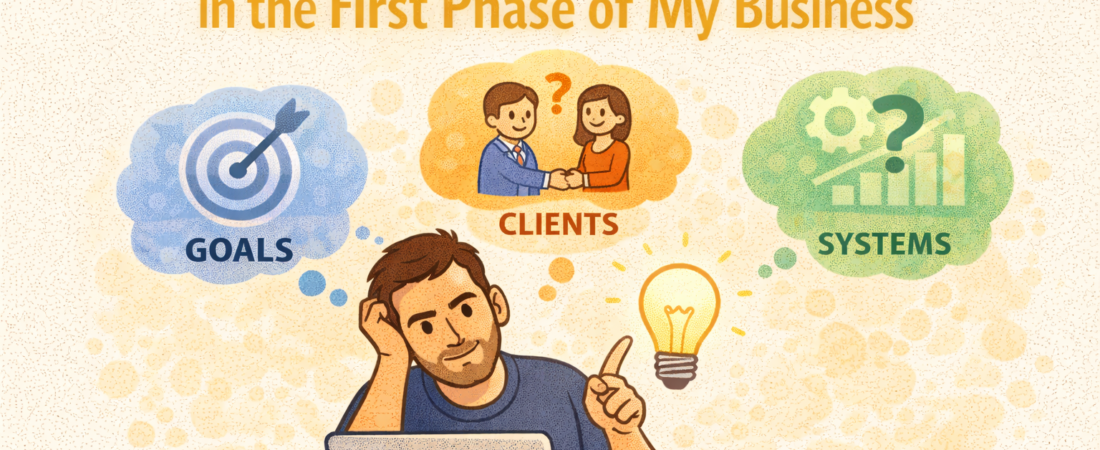
What I Focused On in the First Phase of My Business
Introduction: I Had to Accept That I Was at the Beginning
When I first started my business, I made a quiet mistake.
I acted like I was already supposed to have everything figured out.
I worried about long-term plans, brand image, growth strategies, and future scalability—while still trying to understand the basics. That mismatch created stress and confusion.
Eventually, I accepted something important:
I wasn’t in the growth phase.
I was in the foundation phase.
Once I stopped pretending otherwise, my focus became clearer. This article is about what I actually focused on during that first phase, and what I deliberately ignored.
I Stopped Trying to Do Everything at Once
At the beginning, everything feels urgent.
You feel like you should:
- build an audience
- improve your offer
- learn marketing
- fix your website
- study competitors
- plan for the future
I tried doing all of this at once, and nothing moved forward properly.
So I made a rule for myself:
In the first phase, I’m allowed to focus on only a few things.
This reduced pressure immediately.
I Focused on Understanding the Problem, Not the Perfect Idea
Early on, I spent too much time thinking about ideas.
What finally helped was shifting my attention to problems.
Instead of asking:
- “Is this idea good enough?”
I asked:
- “What problem am I actually trying to solve?”
- “Who experiences this problem regularly?”
- “Do I understand this problem deeply?”
This helped me avoid chasing ideas that sounded exciting but lacked real-world relevance.
I Focused on Learning Through Action, Not Planning
Planning felt productive, but it kept me stuck.
I replaced long planning sessions with small experiments:
- writing something and seeing the response
- sharing ideas publicly
- testing simple offers
- observing what people reacted to
Action gave me feedback.
Feedback gave me clarity.
That clarity never came from planning alone.

I Focused on Building Consistency, Not Speed
In the beginning, I was impatient.
I wanted fast results, quick validation, and signs that I was “on the right path.” That mindset made every slow week feel discouraging.
So I changed my focus.
Instead of asking:
- “How fast am I growing?”
I asked:
- “Can I show up consistently?”
Once consistency became the goal, progress felt more manageable and more sustainable.
I Focused on One Simple Workflow
Rather than building complex systems, I focused on one repeatable workflow.
For example:
- one way I created content
- one way I learned from feedback
- one way I reviewed what worked
This reduced decision fatigue and gave my days structure.
Only later did I expand or optimize.
I Focused on Reducing Confusion Before Increasing Effort
When things felt unclear, my instinct was to work harder.
That usually made things worse.
I learned to pause and ask:
- “What exactly feels unclear right now?”
- “Is the confusion coming from too many options?”
- “What decision am I avoiding?”
Clarifying confusion saved me more time than extra effort ever did.
I Focused on My Own Progress, Not Comparisons
Comparing myself to others slowed me down.
I was comparing:
- my early-stage work
- to someone else’s polished results
That comparison created unnecessary doubt.
So I shifted my focus inward.
My only real question became:
“Am I clearer than I was last month?”
That mindset helped me stay grounded.

I Focused on Learning What Not to Do
One underrated part of the first phase was learning what didn’t work for me.
I paid attention to:
- tasks that drained my energy
- ideas that felt forced
- workflows that created stress
Removing these helped as much as adding the right things.
What I Deliberately Did Not Focus On
This part is just as important.
In the first phase, I intentionally did not focus on:
- scaling
- automation
- perfection
- advanced tools
- big long-term goals
Not because they weren’t important, but because they weren’t important yet.
Timing matters.
What Changed Because of This Focus
By narrowing my focus:
- my days felt simpler
- my decisions felt lighter
- my effort felt more intentional
I wasn’t doing less work, I was doing more relevant work.
That’s what made progress possible.
Why the First Phase Is About Clarity, Not Growth
Looking back, I understand something I didn’t before:
The first phase isn’t about growth.
It’s about understanding.
Understanding:
- the problem
- the process
- your own working style
- what actually matters
Growth comes later, after clarity.

Who This Approach Is For
This approach helped me because:
- I was early-stage
- I felt overwhelmed
- I didn’t want to rush blindly
- I wanted sustainable progress
If you’re in a similar phase, this kind of focus can help you move forward without pressure.
Conclusion: Focusing on Less Helped Me Build More
In the first phase of my business, I didn’t try to do everything.
I focused on:
- learning
- consistency
- clarity
- simple systems
- small progress
That focus created a strong foundation.
If you’re just starting out, don’t worry about doing it all.
Focus on doing the right few things well enough to learn.
That’s what helped me, and it’s often exactly what early-stage businesses need.
If you want a simple, experience-based guide to building a strong business foundation, you can check out my book:
Blueprint to Business Success, written in clear language, is based on real learning and real mistakes.
Related reading
More honest lessons from the journey: