Short answer: divide each client’s revenue by the hours they actually consume, then compare that against what an hour of your time costs to deliver. Most owners find that one or two clients produce almost no profit, and that the biggest biller is often among them. Revenue tells you nothing until you put time next to it.
Nearly every business has at least one client who feels important because of what they pay, and quietly absorbs so much time that they leave nothing behind. You will not spot them from an invoice list, because invoices only show one side of the trade.
Here is how to work out which clients are actually profitable, in about an hour, with no accounting software.
Why revenue per client is misleading
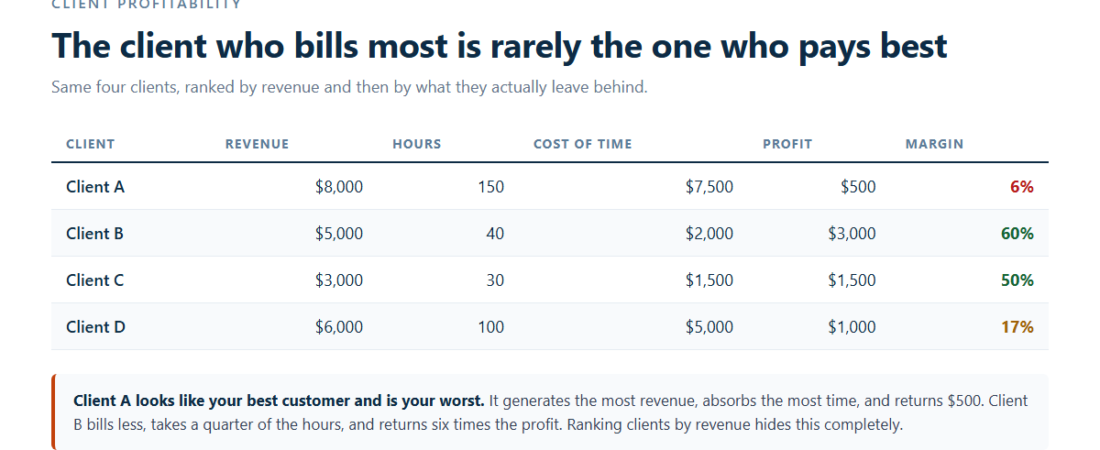
Ranking customers by revenue implicitly assumes every dollar costs the same to earn. It does not. A client who pays $8,000 but consumes 150 hours is buying your time at roughly $53 an hour. A client paying $5,000 for 40 hours is paying $125.
Same business, same month. One of those relationships is more than twice as good as the other, and the revenue column says the opposite.
The calculation
You need three numbers per client, for a single representative month.
- Revenue. What they actually paid, not what you invoiced. Late payments are a cost of their own.
- Hours consumed. All of it. Delivery, meetings, email, revisions, chasing payment, and the mental overhead of work you redid because the brief changed.
- Your loaded hourly cost. Total monthly costs, including your own salary, divided by billable hours available. If your costs are $10,000 a month and you have 100 genuinely billable hours, that is $100 an hour.
Then, for each client:
- Cost to serve = hours consumed × loaded hourly cost
- Profit = revenue − cost to serve
- Margin = profit ÷ revenue × 100
Rank by the last column, not the first. That ranking is usually the uncomfortable part.
The hours nobody counts
Most people get the revenue right and the hours badly wrong, because the expensive hours do not feel like work. Count these:
- Meetings that could have been a message, including the ones they reschedule
- Scope creep absorbed rather than billed, the small favours that never appear on an invoice
- Revisions beyond what was agreed
- Chasing late payment, which is pure cost with no output
- Context-switching, the time to get back into work you have already put down twice
- Emotional load, which is not billable but is real and does reduce what you get done elsewhere
If you have never tracked time, estimate for one week and multiply. An imperfect estimate still beats no data, and the differences between clients are usually large enough that precision does not change the conclusion.
What the numbers usually show
Three patterns come up again and again once people run this properly.
The prestige client is unprofitable. The recognisable name you keep partly because it looks good on a website. They usually know their leverage, negotiate hard, and demand more process than smaller clients.
The quiet client is your best one. Pays on time, asks for little, has clear requirements. Because they generate no drama they get no attention, and they are often the first to be under-served when you are busy.
The bottom client is worse than nothing. Not merely low margin, actually negative once you count the hours honestly. You are paying for the privilege of the work, and the capacity it consumes is capacity you cannot sell to anyone else.
What to do about an unprofitable client
You have four options, and they escalate. Work down the list rather than jumping to the end.
| Option | When it fits |
|---|---|
| Reduce the cost to serve | The work is fine, the process is wasteful. Cut meetings, set response windows, template the repetitive parts. |
| Re-scope | They are getting more than they pay for. Define what is included and bill separately for the rest. |
| Raise the price | The work is genuinely worth more than they pay. Price it correctly at renewal and accept they may decline. |
| Release them | Nothing above works, or the relationship is a net drain. Give notice, finish cleanly, refer them elsewhere if you can. |
Releasing a client feels reckless and usually is not. If a client returns $500 a month for 150 hours, letting them go frees 150 hours. Filling even a third of that with work at a normal margin leaves you better off, and considerably less tired.
One caution worth stating: do not release anyone until you have checked the arithmetic twice and considered concentration risk. If one client is 60% of revenue, an unprofitable relationship may still be worth keeping while you replace it. Fix the margin first, exit second.
How to stop it happening again
- Track hours by client permanently, even roughly. You cannot manage what you never measure.
- Quote on scope, not on time, so that scope creep becomes a conversation rather than an absorbed cost.
- Review margins quarterly. Client profitability drifts as relationships mature and expectations expand.
- Set a floor. Decide the minimum margin you will accept and apply it to new work, where saying no costs nothing.
- Automate the admin that inflates cost to serve. Our guide to improving margins with automation covers where the recoverable time usually sits.
Frequently asked questions
How do I know if a client is profitable?
Multiply the hours they consume by your loaded hourly cost, then subtract that from what they pay. If the result is small relative to the revenue, the client is low margin regardless of how large the invoice looks.
What is a good client margin?
It varies by industry, but for a service business anything under 20% is usually a warning sign, and under 10% means you are working for very little. Compare clients against each other first, since relative ranking is more actionable than a benchmark.
Should I fire an unprofitable client?
Not as a first step. Try reducing your cost to serve, re-scoping, then repricing. Release them only if none of that works, and never if they represent enough revenue that losing them would put the business at risk before you can replace them.
I do not track time. Can I still do this?
Yes. Estimate hours per client for one typical week and scale it up. The gap between your best and worst client is usually so wide that even a rough estimate identifies the problem correctly.
Does this work for products rather than services?
The same principle applies with different inputs. Replace hours with cost of goods, fulfilment and support, then calculate margin per customer segment or per SKU instead of per client.
The short version
Revenue per client is a vanity ranking. Put hours next to it and the real picture appears, usually within an hour of arithmetic. Most businesses discover that a small number of relationships absorb a disproportionate amount of capacity and return almost nothing.
Fixing that is often faster than finding new customers, and it is one of the specific causes behind a business that stays busy without becoming profitable.
Related reading
More on profit and growth: