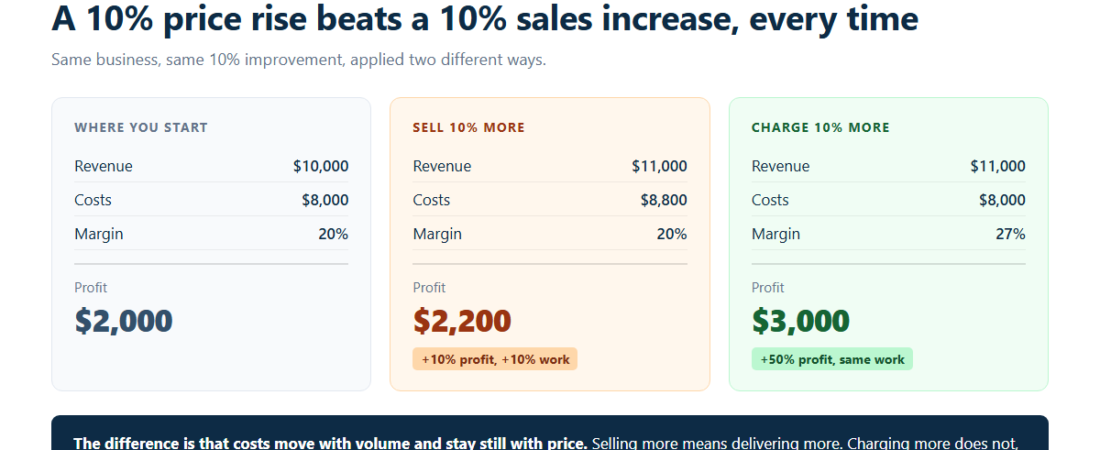
Short answer: raise prices on new customers first, give existing ones notice and a reason, and expect to lose a small number of your least profitable clients. A 10% increase typically improves profit far more than a 10% increase in sales, because costs move with volume and stay still with price.
Most owners know their prices are too low and put off doing anything about it, because the risk feels one-sided. Raise prices and customers might leave. Keep them and nothing bad happens today.
That trade is not what it appears. Underpricing does not avoid the cost, it just spreads it across every hour you work. Here is how to fix it without wrecking your customer base.
Why price beats volume
This is the argument that changes minds, because it is arithmetic rather than opinion.
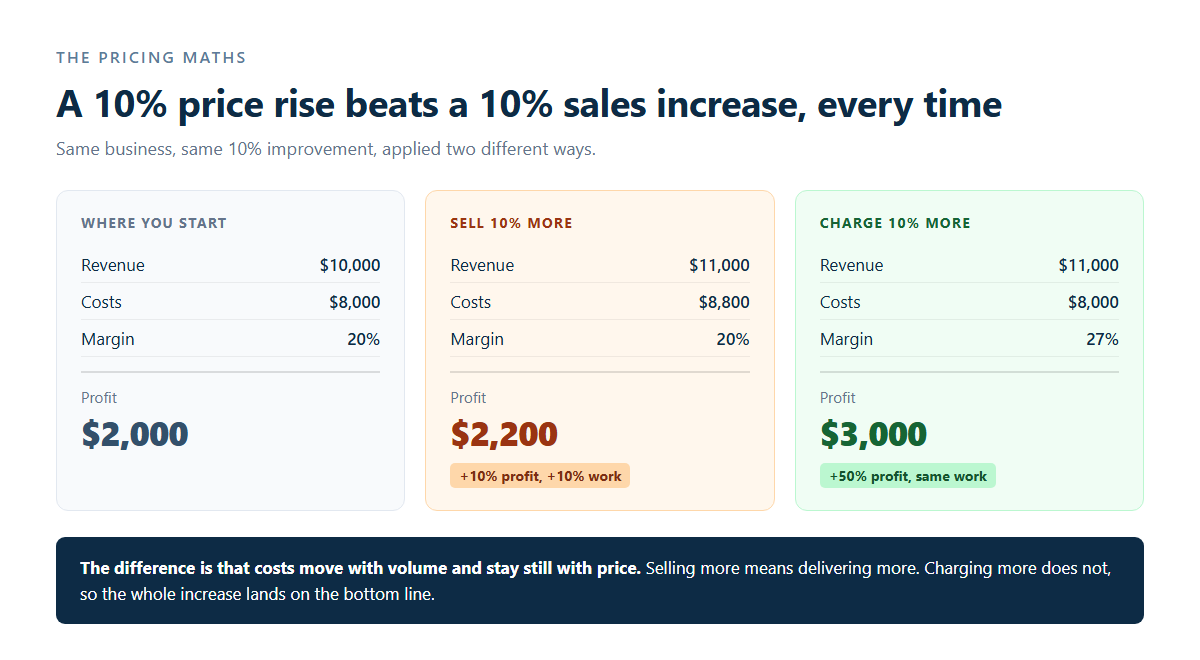
Selling 10% more means delivering 10% more, so your costs rise with it and profit grows proportionally. Charging 10% more costs you nothing extra to deliver, so the entire increase lands on the bottom line.
The lower your current margin, the more dramatic this gets. At a 20% margin, a 10% price rise increases profit by 50%. At a 10% margin, the same increase roughly doubles it. Thin margins make pricing the single highest-leverage change available to you.
How much can you lose and still come out ahead?
This is the question people should ask and rarely do. You do not need to keep every customer. You need to keep enough of them.
Using the same business as above, at a 20% margin with a 10% price increase, you could lose roughly a quarter of your revenue and still make the same profit as before. Everything you retain beyond that is gain, and you would be doing significantly less work for it.
| Your current margin | Revenue you can lose after a 10% price rise and break even |
|---|---|
| 10% | About 33% |
| 20% | About 25% |
| 30% | About 20% |
| 50% | About 14% |
In practice, almost nobody loses those numbers. Typical churn from a single-digit or low double-digit increase, communicated properly, is a handful of accounts, and they are usually the ones already costing you the most to serve.
Start with new customers
The safest place to raise prices is where there is no relationship to damage. Quote the new rate to everyone who enquires from today. No announcement, no negotiation, no risk to existing revenue.
This does two useful things. It tells you within a few weeks whether the market accepts the number, using real enquiries rather than your own nerves. And it gradually shifts your customer base toward the new rate without a single difficult conversation.
If enquiries convert at roughly the same rate as before, your old price was too low and you now have evidence. Raise it again in a few months.
Then move existing customers
Existing customers are where the anxiety lives, and where most of the revenue usually is. Four rules make this go smoothly.
- Give proper notice. Thirty days minimum, sixty is better for larger accounts. Surprise is what causes anger, not the number itself.
- Tell them once, clearly. One direct message stating the new price and the date it starts. Do not bury it in a newsletter or hint at it across several emails.
- Give a reason, briefly. Rising costs, expanded scope, or simply that rates have not changed in some years. One sentence. Long justifications read as apology and invite negotiation.
- Do not apologise. You are correcting a price, not asking a favour. Tone carries more than wording here.
A workable template:
Hi [name], a quick note that our rates are changing from [date]. Your [service] will move from [old] to [new] per [period]. Our costs have risen and rates have been unchanged since [year]. Everything else about how we work together stays the same, and I am happy to talk it through if useful.
Short, specific, no defensiveness. Most replies will be a single word of acknowledgement.
Handling the pushback
Some customers will object. Very few will actually leave over it. The distinction matters, because treating an objection as a departure is how people talk themselves back down.
| What they say | What to do |
|---|---|
| That is a big jump. | Acknowledge it, restate the reason once, hold the number. Offer a phased increase over two steps if the relationship warrants it. |
| Can you make an exception for us? | Only in exchange for something: longer commitment, faster payment terms, reduced scope. Never for nothing. |
| We will have to look at alternatives. | Say you understand, and offer to help with a handover. Most do not follow through, and the ones who do were price-shopping already. |
| Our budget is fixed. | Reduce the scope to fit the budget rather than the price. Same rate, less work. |
That last one is the most useful move in the list. Cutting scope keeps your rate intact and puts the decision in their hands, which is a much better position than discounting.
How much to raise
- Under 10% rarely triggers objections but also rarely fixes a genuinely underpriced business. Fine as an annual adjustment.
- 10% to 20% is the usual sweet spot for correcting years of drift. Expect a few conversations, minimal churn.
- Over 25% works, but phase it. Two increases six months apart cause less disruption than one large jump, unless you are deliberately repositioning.
If you have no idea where to start, look at what your least price-sensitive customers pay without complaint. That number is usually closer to your real market rate than your current list price.
Before you raise anything
Two checks are worth doing first, because they change what the right number is.
Know your current margin. A price rise on top of an unmeasured cost base is guesswork. If you cannot state your margin, start there, because it determines how much room you actually have.
Know which customers are already unprofitable. Some accounts will not be worth keeping at any realistic price, and a price rise is a clean way to let them self-select out. Our guide to working out which clients are actually profitable covers the calculation.
Frequently asked questions
How often should I raise prices?
Annually, as a matter of routine. Businesses that review prices every year rarely need a dramatic correction. Businesses that leave it for five years eventually need a 40% increase and a difficult month.
Will I lose customers if I raise prices?
Probably a few, and usually the least profitable ones. The relevant question is not whether anyone leaves, but whether the extra margin on those who stay exceeds what the leavers were contributing. At typical margins it comfortably does.
Should I tell customers why prices are going up?
Yes, in one sentence. A brief reason reads as professional. An extended justification reads as uncertainty and invites negotiation you did not need to have.
What if a competitor is cheaper?
There is nearly always someone cheaper, and matching them is a race you lose slowly. Compete on outcome, reliability or specialism instead. Customers who buy purely on price were never loyal to begin with.
Should I grandfather existing customers?
Only briefly, and only with an end date. Permanent grandfathering means your best long-term customers eventually become your least profitable, which is precisely backwards.
The short version
Price is the fastest lever you have, because unlike cutting costs or winning customers, the entire increase becomes profit. Start with new enquiries where the risk is nil, give existing customers clear notice and one reason, and hold the number when someone pushes.
Underpricing is one of the most common reasons a business stays busy without becoming profitable, and it is the one that takes an afternoon to fix rather than a year.
Related reading
More on profit and growth: