Short answer: take what the business actually left you last month, divide it by the hours you actually worked, and compare that number to what you would earn doing the same work for someone else. Most owners have never run this calculation. A significant number who do find their business pays worse than a job.
Nobody asks this question, because the answer is uncomfortable and there is always something more urgent to do. Revenue gets quoted at dinner parties. Profit gets checked at tax time. The hourly number gets checked essentially never.
It takes about four minutes to work out, and it changes what you do next more than almost any other number in the business.
What a normal-looking business actually pays
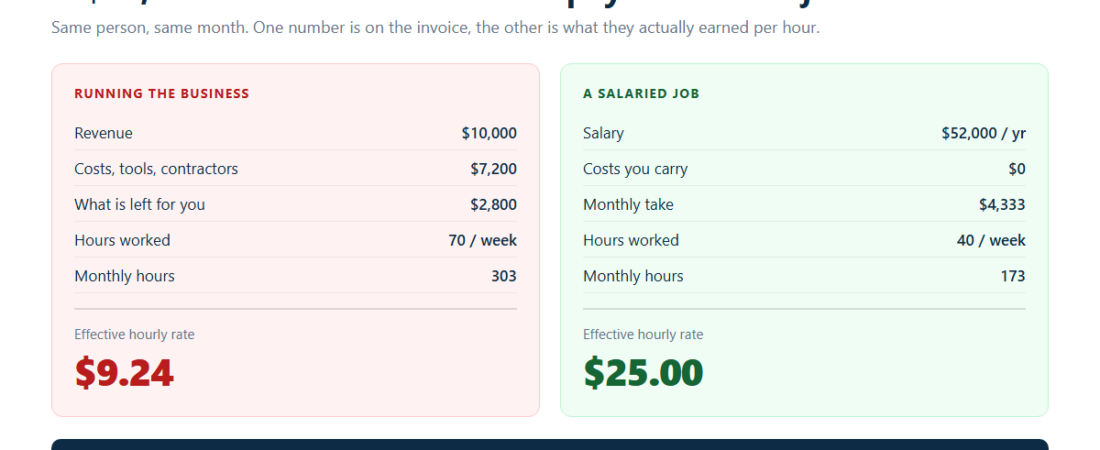
Here is a business nobody would describe as failing. Ten thousand a month coming in, growing, owner is busy, everyone assumes it is going well.
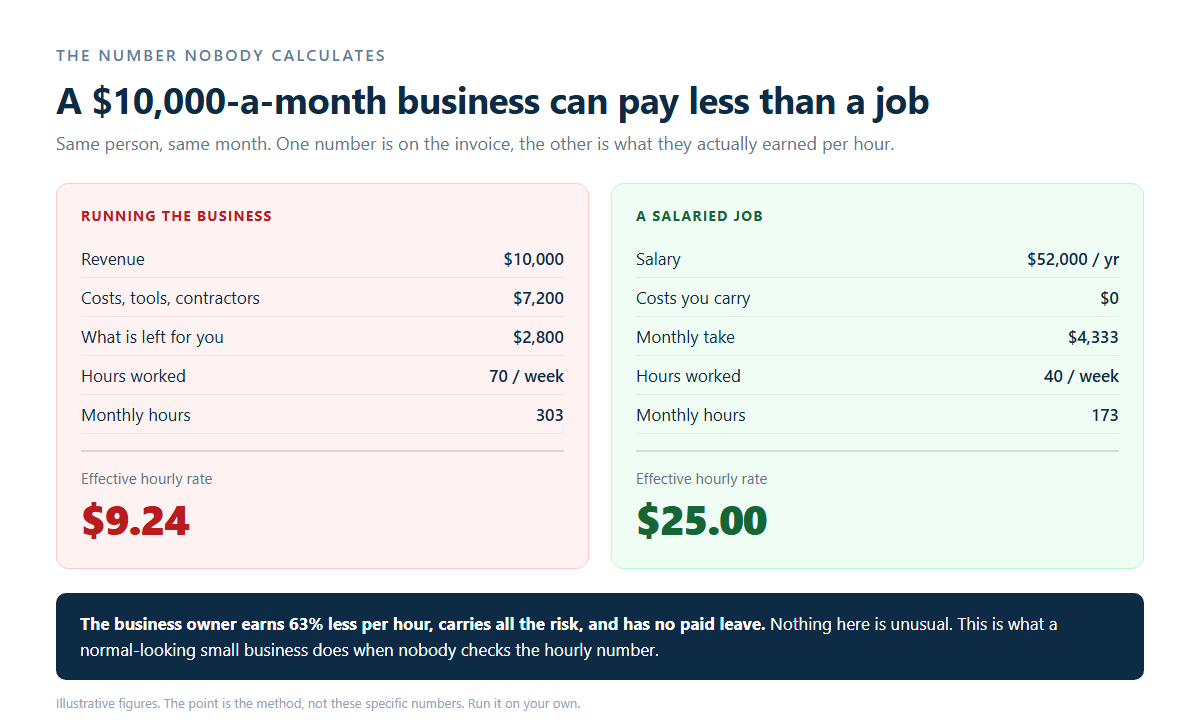
Nothing in that column is unusual. Costs at 72% of revenue is ordinary for a service business carrying tools, contractors and software. Seventy hours a week is what a lot of owners genuinely work once you count evenings and weekends properly.
The result is that the person who carries all the risk, has no paid leave, no sick pay and no employer contributions, earns roughly a third of what the salaried version of themselves earns per hour.
Run it on yourself
Three numbers, one month, no software required.
- What the business actually left you. Money in, minus everything that went out. Not what you invoiced. Not what is owed to you. What genuinely landed and stayed.
- Hours you actually worked. Be honest about this one. It is the number people fudge, and fudging it is how you avoid the answer.
- Divide. That is your effective hourly rate.
Then compare it to what someone would pay you to do the same work as an employee. That comparison is the whole point. If the number comes out lower, you are effectively paying for the privilege of owning the business.
The hours people leave out
Most people underestimate hours by twenty to forty percent, because only some of the work feels like work. Count all of it:
- Admin, invoicing, chasing payment
- Quoting work you did not win
- Email and messages outside working hours
- The Sunday evening you spent catching up
- Thinking about a problem while doing something else, which is real cognitive work even if it is hard to log
- Anything you would be paid for if an employer asked you to do it
If your instinct is to exclude something because it does not count, that is usually the strongest sign it should be counted.
What a bad number actually means
It does not mean the business is a mistake, and it does not mean you should get a job. It means one of four things, and each has a different fix.
| What the number suggests | Where the problem actually is |
|---|---|
| Revenue is healthy, rate is poor | Costs. Something is eating the margin between the two. |
| Margin is fine, rate is still poor | Hours. You are delivering too much for what you charge. |
| Both look fine, rate is poor | Pricing. You are efficient at work that is underpriced. |
| Rate is fine but you feel broke | You are probably reinvesting more than you realise. Not a problem, but worth knowing deliberately. |
The useful part is that this diagnoses in one number what usually takes months of vague unease to work out.
Why so many businesses land here
Not because owners are careless. Because every incentive points away from the calculation.
Revenue is the number everyone asks about. Nobody at a networking event asks what you earn per hour. They ask what the business turns over, so that becomes the number you optimise and the number you quote.
Growth hides it. Rising revenue feels like progress even when the hourly rate is falling, and it usually is falling, because growth adds hours faster than it adds margin.
The work is genuinely absorbing. When you are busy, checking whether being busy is worth it feels like a luxury. So it gets deferred, sometimes for years.
The answer is emotionally expensive. A low number implies something has to change, and change is harder than continuing. Plenty of people sense the answer and quietly decline to confirm it.
What to do with the number
Do not make a dramatic decision off one month. Run it for three, because a single bad month proves nothing and a single good one proves less.
Then pick the cheapest lever first. In order of how quickly they move the number:
- Cut costs. Entirely within your control, works immediately, no conversations required.
- Raise prices. The whole increase becomes profit, because costs do not move with it. Covered in how to raise your prices without losing customers.
- Drop the worst clients. Usually the ones consuming the hours that are dragging the rate down. The calculation is in working out which clients are actually profitable.
- Reduce the hours. Automate admin, stop quoting work you rarely win, set boundaries on response times.
Most people can move the number meaningfully with the first two alone, and both are achievable inside a month.
Frequently asked questions
What is a good effective hourly rate for a business owner?
At minimum, more than you would earn as an employee doing the same work, because you are carrying risk, unpaid leave and no employer contributions. A common benchmark is at least 1.5 times the salaried equivalent. Below parity, the business is costing you money in exchange for autonomy.
Should I include my own salary as a cost?
Not for this calculation. Here you want what the business left for you in total, whether you took it as salary, drawings or left it in the account. Counting your salary as a cost and then measuring what is left produces a different, less useful number.
What if I am reinvesting everything?
Then run it twice, once counting reinvestment as a cost and once not. The gap between the two tells you what you are actually betting on the future, which is worth knowing as a deliberate decision rather than an accident.
Is a low rate always a reason to quit?
No. Early-stage businesses often run at a poor hourly rate while building something with value beyond the monthly income. The problem is not a low number, it is a low number you never checked and cannot explain. Deliberate is fine. Unexamined is not.
How often should I check it?
Quarterly is enough. It drifts slowly, and checking it too often turns a strategic number into a source of anxiety.
The short version
Revenue is what the business does. Your effective hourly rate is what the business does for you, and they are frequently unrelated. One number takes four minutes and tells you whether the last year was worth it.
If the answer is uncomfortable, that is useful information rather than a verdict. It usually points at pricing or costs, both of which are fixable, and it is one of the clearest signs of a business that stays busy without becoming profitable.
Related reading
More on profit and growth: