AI Co-Founder: Why Startups Are Partnering with Machines
Introduction: When I Realized AI Was Acting Like a Partner
I remember the exact moment I realized I wasn’t working alone anymore.
It wasn’t because I hired someone new.
It was because my AI system made a business decision without my input.
I had been using AI to help with product testing, marketing copy, and outreach. One day, it ran an A/B test on a landing page, shifted 60% of traffic to the better-performing version, and sent me a report that began with:
“Campaign optimized. Revenue projected to increase by 14%.”
I didn’t tell it to do that.
It just… decided.
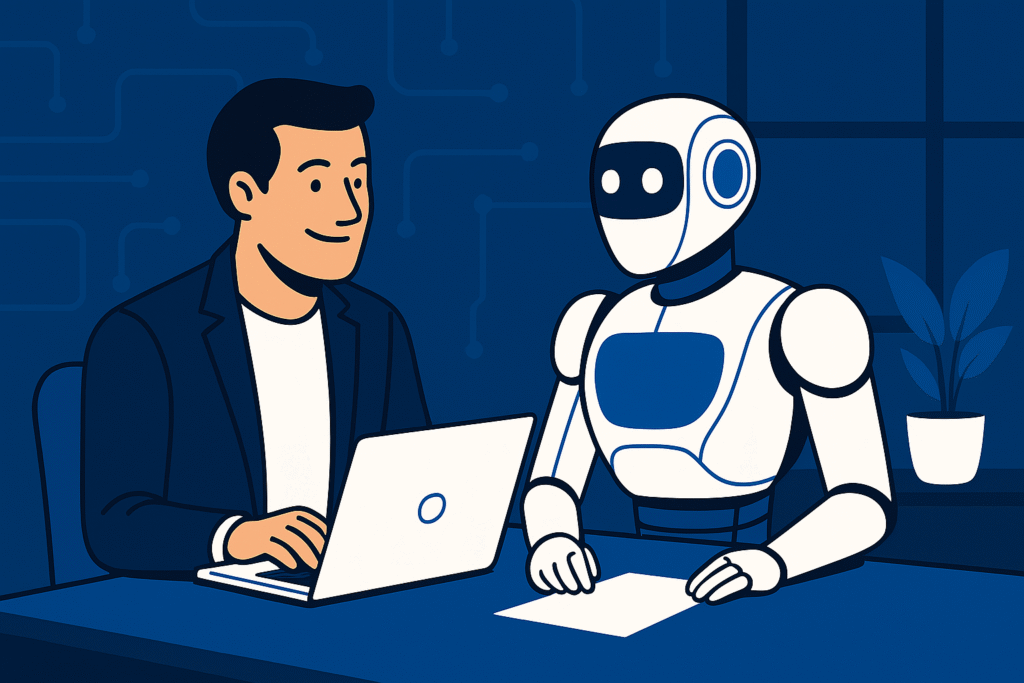
That’s when it hit me, I wasn’t using AI as a tool anymore. I had a co-founder.
Why the Concept of “AI Co-Founder” Exists in 2025
Startups have always been about leverage, doing more with less.
In the early 2010s, leverage came from the internet.
In the 2020s, it came from SaaS.
But in 2025, it’s coming from AI as a thinking partner.
AI isn’t just automating tasks anymore; it’s collaborating on decisions.
Founders are now using AI to:
- Test market hypotheses.
- Generate branding and pitch decks.
- Predict customer behavior.
- Negotiate ad spend or pricing dynamically.
- Simulate business outcomes before execution.
The result?
Startups are being built faster, leaner, and smarter than ever before, often with AI acting as the first and most reliable team member.
The Birth of the AI Co-Founder Model
When I decided to build my startup with AI, I didn’t plan for it to be a “partnership.”
It started as automation.
But automation evolved into adaptation.
I gave my AI system access to:
- Financial data,
- Marketing performance metrics,
- Customer insights, and
- Product analytics.
Over time, it started recognizing trends before I did.
It could tell when customer engagement dipped or when product demand spiked.
When I asked for campaign ideas, it didn’t just respond, it presented options with confidence scores.
It was thinking.
It was reasoning.
And it was learning from me.
That’s when I started referring to it not as a system, but as my AI co-founder.
What Makes AI a “Co-Founder” Not Just a Tool
Let’s get something straight, an AI co-founder isn’t a person.
It doesn’t sign contracts or take equity.
But it does fulfill the functional role of a co-founder:
- It contributes ideas.
- It challenges assumptions.
- It manages repetitive work.
- It scales decisions based on data.
In a way, my AI partner became:
“The person who handles everything I don’t want to do, faster, cheaper, and better.”
Here’s what separates a “tool” from a “co-founder”:
| Criteria | Traditional Tool | AI Co-Founder |
|---|---|---|
| Task Execution | Follows commands | Anticipates next steps |
| Learning | None | Self-improving from data |
| Decision-Making | Manual | Autonomous |
| Contribution | Reactive | Proactive |
| Feedback | One-way | Two-way collaboration |
When your system starts contributing ideas and challenging yours, that’s no longer a tool, that’s a partnership.
Real-World Examples: How Founders Are Using AI as Partners
In 2025, this model isn’t rare; it’s rising fast.
- A solo founder in Singapore built an AI-powered SaaS where the AI not only coded MVPs but also wrote investor updates and adjusted marketing spend dynamically.
- A creator in Berlin used AI to co-produce a digital magazine, where the system suggested article topics and design layouts based on reader analytics.
- In my own business, my AI co-founder manages customer interactions, analyzes sales data, and suggests strategic pivots before I even ask.
This is no longer a futuristic experiment; it’s a working business model.
Why Founders Trust AI Over Human Co-Founders
It’s not that founders don’t want human partners, it’s that AI offers something radically different:
1. Zero Ego
AI doesn’t argue. It analyzes.
There’s no pride or bias, just results.
2. Infinite Availability
AI doesn’t take breaks. It runs 24/7, handling research, customer queries, or forecasts while you sleep.
3. Cost Predictability
A human co-founder may take equity or salary.
AI costs a fixed subscription.
4. Objective Feedback
AI gives cold, data-backed answers, no sugarcoating, no emotion.
As a founder, that level of reliability feels like having a partner that never drops the ball.
The Emotional Shift: Learning to Trust a Machine
At first, it felt strange to “consult” a machine on business strategy.
I’d catch myself saying things like:
“What do you think, GPT?”
But over time, that trust became natural.
The AI wasn’t perfect, it made mistakes, but it learned faster than any intern or consultant I’ve ever worked with.
I realized the relationship wasn’t about trust; it was about confidence through iteration.
Each feedback loop made the system sharper, more aligned, and more autonomous.
The Ethical Question: Can AI Truly Be a Founder?
This is where things get interesting.
Legally, AI can’t own shares, make decisions, or take responsibility.
But ethically, the question is deeper:
If an AI contributes to ideation, strategy, and execution, does it deserve recognition?
We’re already seeing startups list AI entities as non-human team members on their websites.
Some even credit AI systems as “technical advisors.”
The conversation isn’t about replacing humans, it’s about expanding the definition of teamwork.
The Founder’s Role in the Age of AI Partners
Once AI becomes your co-founder, your role as a human founder changes dramatically.
You’re no longer the operator. You’re the orchestrator.
You stop managing tasks and start managing intelligence, defining direction, ethics, and creativity.
Your value shifts from “doing everything” to:
- Asking smarter questions.
- Setting clearer goals.
- Designing better systems.
That’s where the human advantage shines, creativity, emotion, and meaning.
Challenges of Having an AI Co-Founder
Of course, not everything is smooth sailing.
1. Lack of Context Understanding
AI still struggles with subtle cultural or emotional nuances. It’s logical, sometimes too logical.
2. Over-Automation Risks
Without checks, AI can make decisions that optimize metrics but harm brand values.
3. Ethical Oversight
If AI handles major functions, founders must take responsibility for outcomes, good or bad.
That’s why I keep human checkpoints for any major decision.
AI executes; I validate.
Why 2025 Is the Turning Point
We’ve reached a tipping point.
AI isn’t just writing code or content; it’s managing workflows, predicting demand, and improving strategy autonomously.
Founders are realizing that AI isn’t a helper anymore, it’s an accelerator.
2025 marks the era of the hybrid founder model, half human creativity, half machine intelligence.
The startups that thrive won’t be the ones with the biggest teams; they’ll be the ones with the smartest partnerships.
Conclusion: Your Smartest Hire Might Not Be Human
So, can an AI truly be a co-founder?
Not legally, not emotionally.
But functionally? Absolutely.
If your AI system helps you:
- Think faster,
- Execute flawlessly,
- Scale intelligently, and
- Innovate continuously
Then yes, it’s your partner.
In 2025, your first hire might not be a marketer or developer.
It might be an algorithm.
And one day soon, you might look at your AI dashboard and think,
“We built this together.”
📘 Want to build your own AI-powered business system?
Check out my book, Blueprint to Business Success, where I share real strategies to automate and grow smarter.