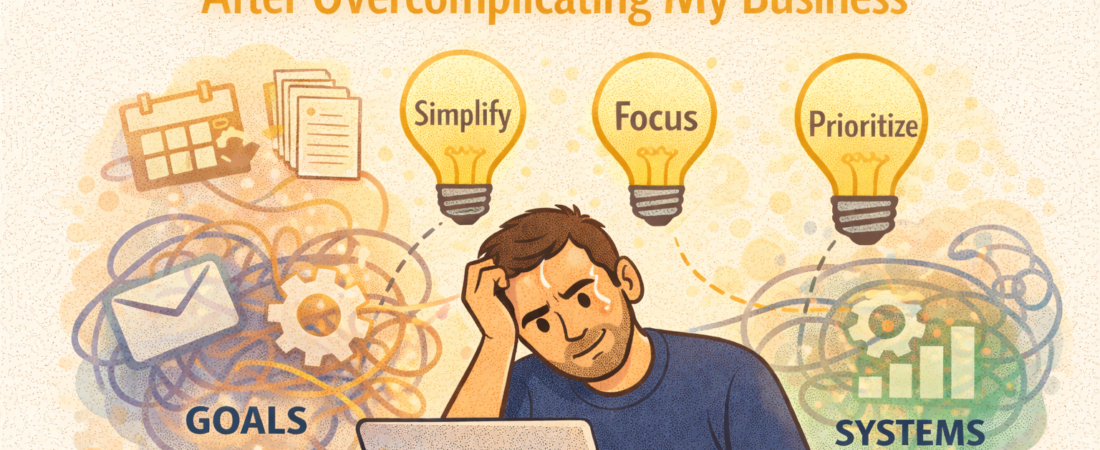
What I Learned After Overcomplicating My Business
Introduction: When My Business Started Feeling Heavier Than It Should
There was a point when my business felt exhausting, not because it was big, but because it was too complicated.
Every day came with too many decisions.
Too many ideas.
Too many things I thought I should be doing.
I wasn’t struggling because I lacked effort or motivation.
I was struggling because I had overbuilt everything too early.
This article is about what I learned during that phase, when I realized that most of my problems weren’t external. They were self-created.
How I Slowly Overcomplicated My Business Without Realizing It
The tricky part about overcomplication is that it doesn’t happen all at once.
It happens quietly.
For me, it started with good intentions:
- “This will make things more professional.”
- “This will help me scale later.”
- “Everyone else is doing this, so I should too.”
One by one, I added:
- more processes
- more planning
- more structure
- more ideas
- more pressure
Eventually, my business stopped feeling simple, and started feeling heavy.
The First Sign: I Spent More Time Managing Than Creating
One day, I noticed something strange.
I was spending more time organizing work than doing work.
I was:
- planning instead of executing
- adjusting systems instead of using them
- refining workflows that weren’t even proven yet
That’s when I realized I had crossed a line.
I was optimizing something that didn’t need optimization.
Why Overcomplication Felt Like Progress at First
Overcomplication feels productive.
It looks like:
- being serious
- being prepared
- thinking long-term
- “doing things properly”
But what I learned is this:
Complexity often hides uncertainty.
Instead of testing ideas, I was building structures.
Instead of learning from action, I was protecting myself with planning.
Overcomplication gave me the feeling of control, but not real progress.

What I Was Actually Afraid Of
When I looked honestly at my behavior, I realized something uncomfortable.
I was afraid of:
- choosing the wrong direction
- looking unprofessional
- starting small
- failing publicly
So I overbuilt to feel safe.
But that safety came at a cost, clarity.
The Moment I Knew Something Had to Change
The turning point came when I asked myself a simple question:
“If someone asked me what my business actually does, could I explain it clearly?”
I couldn’t.
That scared me more than being small or slow ever did.
If I couldn’t explain my business, how could anyone else understand it?
That’s when I decided to simplify, on purpose.
Step 1: I Stripped My Business Back to the Basics
Instead of fixing everything, I removed things.
I asked:
- “What is absolutely essential right now?”
- “What can wait?”
- “What am I doing just because I think I should?”
I paused:
- unnecessary processes
- extra planning
- ideas that weren’t active
- tools I wasn’t really using
My business immediately felt lighter.
Step 2: I Focused on One Clear Outcome at a Time
One big mistake I made was trying to improve everything simultaneously.
Marketing.
Content.
Systems.
Branding.
Learning.
That never worked.
So I changed my approach:
One outcome. One focus. One period of time.
This reduced mental overload and made progress measurable again.

Step 3: I Simplified My Language (This Matters More Than It Sounds)
Another subtle form of overcomplication was language.
I used complex terms, even with myself.
Once I simplified how I talked about my business, I also simplified how I thought about it.
Clear language, clear thinking.
Step 4: I Stopped Building for a Future I Wasn’t Ready For
This was a big lesson.
I realized I was building systems for:
- scale I didn’t have yet
- problems I hadn’t reached
- complexity I didn’t need
So I shifted my mindset:
Build for now, not for someday.
When the future arrives, I’ll adjust.
What Changed After I Simplified
The changes weren’t dramatic, but they were powerful.
- I made decisions faster
- I felt less overwhelmed
- I finished things more often
- I enjoyed the work again
Most importantly, my effort started making sense.
What I No Longer Believe
After overcomplicating my business, here’s what I no longer believe:
- complexity equals professionalism
- more structure equals progress
- copying others leads to clarity
- planning guarantees success
None of these helped me when I was stuck.
What I Believe Now
What I believe now is simple:
- clarity beats complexity
- progress beats perfection
- action beats planning
- simplicity scales better than chaos
A business doesn’t need to be impressive.
It needs to be understandable.
Why Overcomplication Is Common (Especially Early On)
I don’t blame myself for this phase.
Overcomplication happens because:
- you care
- you want to do things right
- you don’t want to waste time
Ironically, that’s what makes it dangerous.
The solution isn’t working harder, it’s removing what doesn’t matter yet.
Who This Article Is For
This is for you if:
- your business feels harder than it should
- you’re managing more than creating
- you feel mentally overloaded
- you keep adding instead of simplifying
You’re not behind.
You’re just doing too much too soon.
Conclusion: Simplicity Didn’t Limit My Business, It Saved It
Overcomplicating my business didn’t make me smarter or more prepared.
It made me slower and more confused.
Simplifying didn’t reduce my ambition, it gave it direction.
If your business feels heavy, don’t assume you need more.
Ask if you need less.
That question changed everything for me.
📘 If you want a clear, experience-based approach to building a business without unnecessary complexity, you can check out my book:
Blueprint to Business Success, written in simple language, based on real learning and real mistakes.