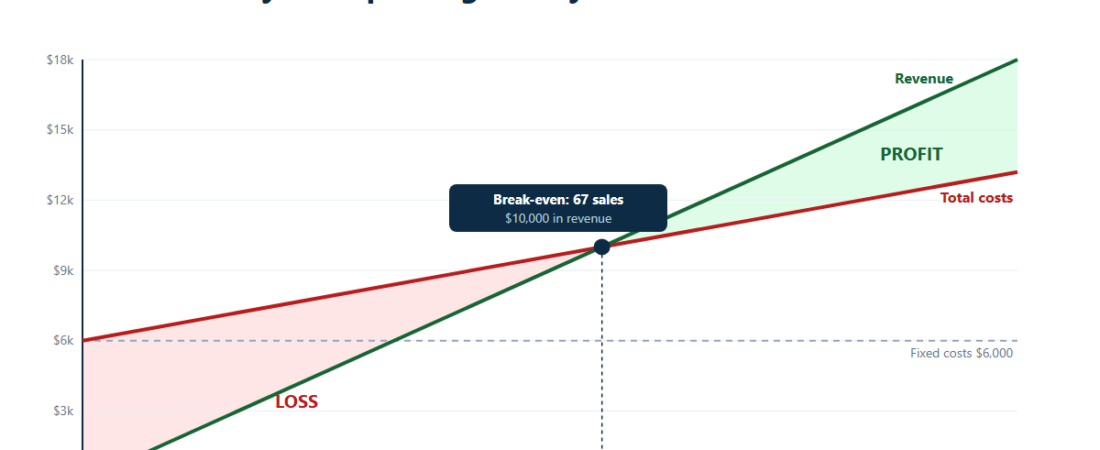
Short answer: your break-even point is your monthly fixed costs divided by what each sale contributes after its own direct costs. If you have $6,000 in fixed costs and each sale leaves $90 after direct costs, you need 67 sales a month before you make a single dollar of profit. Use the calculator below with your own numbers.
Ask most business owners how many sales they need this month just to stop losing money, and you will get a pause, then a guess. It is the most important number in a small business and one of the least known.
That matters because every decision downstream depends on it. Whether you can afford to hire. Whether a discount is safe. Whether a slow month is a problem or a disaster. Without the break-even number, all of those are guesses dressed up as judgement.
It takes about two minutes to work out. The calculator does it for you.
Break-even calculator
Start with rough numbers if you do not have exact ones. The result will be close enough to change a decision, and you can refine it later.
What break-even actually looks like
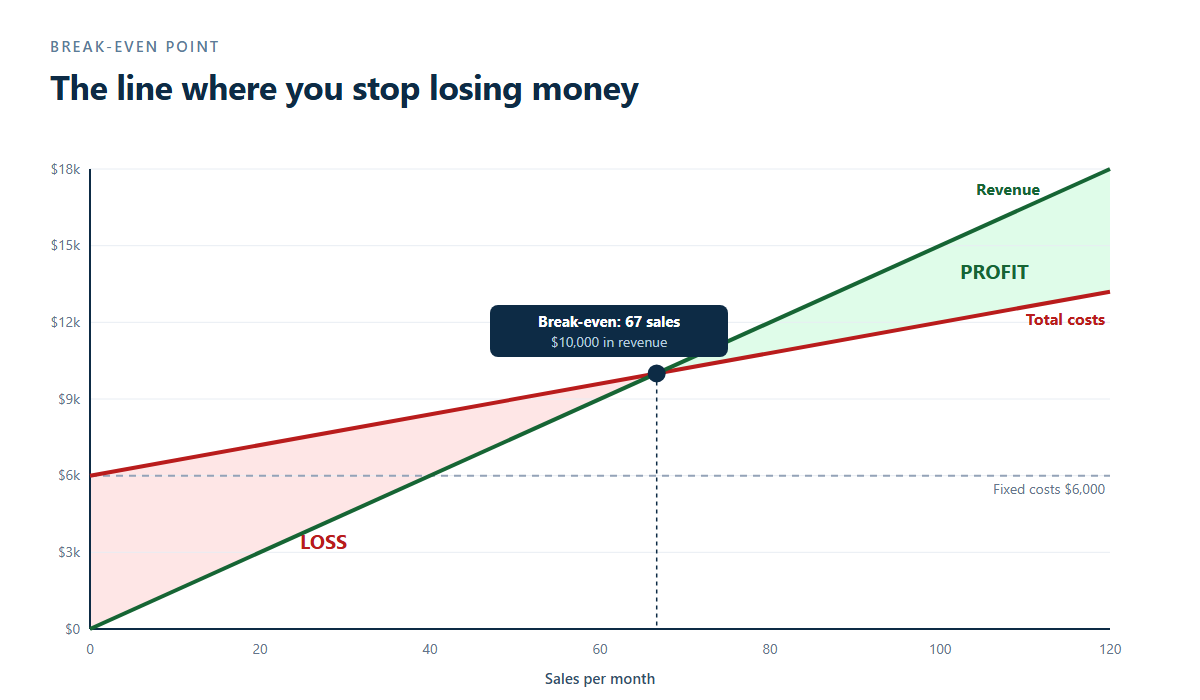
Your costs never start at zero. Rent, software and salaries are due whether you sell anything or not, so the cost line starts high and rises slowly with each sale. Revenue starts at zero but rises faster. The point where they cross is break-even.
The shape explains something that confuses a lot of owners: why the first sales of the month feel like they achieve nothing. They are paying off fixed costs. Profit only begins after the crossing point, and then it builds quickly.
The formula
Two steps.
- Contribution per sale = price per sale − variable cost per sale
- Break-even sales = monthly fixed costs ÷ contribution per sale
To express it as revenue instead of units, multiply break-even sales by your price.
Worked through: fixed costs of $6,000, a price of $150, and a variable cost of $60 per sale gives a contribution of $90. Divide $6,000 by $90 and you get 66.7, so you need 67 sales a month, which is $10,000 in revenue. Every sale after the 67th adds $90 of profit.
Fixed or variable? The part everyone gets wrong
The calculation is simple. Sorting costs into the right bucket is where it goes wrong, and a mistake here quietly corrupts the answer.
The test is one question: if you made zero sales next month, would you still pay this? If yes, it is fixed. If it would disappear, it is variable.
| Usually fixed | Usually variable |
|---|---|
| Rent and utilities | Materials and stock |
| Salaries, including yours | Payment processing fees |
| Software subscriptions | Shipping and packaging |
| Insurance and accounting | Sales commissions |
| Loan repayments | Freelancers paid per job |
Two mistakes are especially common. The first is leaving out your own salary, which makes break-even look far lower than it is and produces a business that technically breaks even while paying its owner nothing. Include what you actually need to take out.
The second is forgetting payment fees. A card processor taking 3% of every sale is a variable cost, and on thin margins it moves the break-even point noticeably.
Margin of safety: the number that tells you how worried to be
Break-even tells you where the line is. Margin of safety tells you how far above it you are, which is what actually determines whether a bad month is survivable.
Margin of safety = (current sales − break-even sales) ÷ current sales
At 80 sales against a break-even of 67, your margin of safety is about 17%. Sales could fall by roughly a sixth before you start losing money. That is a thin buffer. One lost client or one quiet month and you are underwater.
- Under 10%: fragile. A single bad month creates a loss.
- 10% to 25%: workable, but volatility will hurt. Build a cash reserve.
- Over 25%: genuinely resilient. You can absorb a real downturn.
Most owners have never calculated this, and it is the single best predictor of whether next month will feel stressful.
What to do if you are below break-even
There are only four levers, and they are not equally powerful. The calculator above lets you test each one: change one number and watch what happens to break-even.
| Lever | Effect on break-even | How hard |
|---|---|---|
| Raise your price | Largest. Every dollar goes straight to contribution. | Moderate. Needs a conversation, not capital. |
| Cut variable costs | Large. Same effect per dollar as a price rise. | Varies. Renegotiate suppliers, fees, packaging. |
| Cut fixed costs | Direct and immediate. | Easiest. Cancel what you do not use. |
| Sell more | Moves you further from break-even, but does not lower it. | Hardest and slowest. |
Try it in the calculator. Raising the price from $150 to $165 in the default example drops break-even from 67 sales to 58. That is nine fewer sales needed every month from a single change, with no extra work.
Notice that selling more is the one lever that does not actually move the break-even point. It is also the one most owners reach for first. Pricing is almost always the faster fix, and we cover how to do it without losing customers in how to raise your prices without losing customers.
Break-even for service businesses
If you sell time rather than products, the same logic works with hours. Your variable cost per sale is usually small, so contribution is close to your full rate, and break-even becomes a question of billable hours.
Treat one billable hour as one sale. Enter your hourly rate as the price, anything you spend per hour of delivery as the variable cost, and your monthly fixed costs as normal. The result is how many billable hours you need each month to cover the business.
Then compare that against how many billable hours you realistically have. If break-even needs 140 billable hours and you only manage 100 once admin and sales are accounted for, the business cannot work at its current price, however busy you are. That same gap between effort and reward is covered in the $10,000-a-month business that pays $9 an hour.
Frequently asked questions
What is a break-even point?
The level of sales at which total revenue exactly equals total costs, so the business makes neither a profit nor a loss. Below it you lose money every month. Above it, each additional sale contributes to profit.
How do I calculate break-even quickly?
Subtract the variable cost of one sale from its price to get the contribution per sale. Then divide your monthly fixed costs by that contribution. The answer is how many sales you need each month to cover everything.
Should I include my own salary in fixed costs?
Yes. If you leave it out, your break-even point will look lower than it really is, and you will be breaking even on a business that pays you nothing. Include what you genuinely need to take out each month.
What if my contribution per sale is negative?
Then no volume of sales will ever break even, because every sale loses money before fixed costs are even considered. Selling more makes it worse. The only fixes are raising the price or cutting the cost of each sale.
How often should I recalculate it?
Whenever a cost or price changes, and at least quarterly otherwise. Fixed costs creep upward through small additions, and break-even drifts up with them without anyone noticing.
What is a good margin of safety?
Above 25% is resilient enough to absorb a genuine downturn. Between 10% and 25% is workable but exposed. Below 10% means a single bad month produces a loss, and a cash reserve becomes essential.
The short version
Divide fixed costs by what each sale contributes, and you know how many sales you need before profit starts. Then check your margin of safety, because the gap above break-even is what decides whether a slow month is an inconvenience or a crisis.
If you are below the line, reach for price and costs before volume. They move break-even directly, and volume does not. Being stuck under it for months is one of the clearest signs of a business that stays busy without becoming profitable.
Related reading
More on profit and growth: