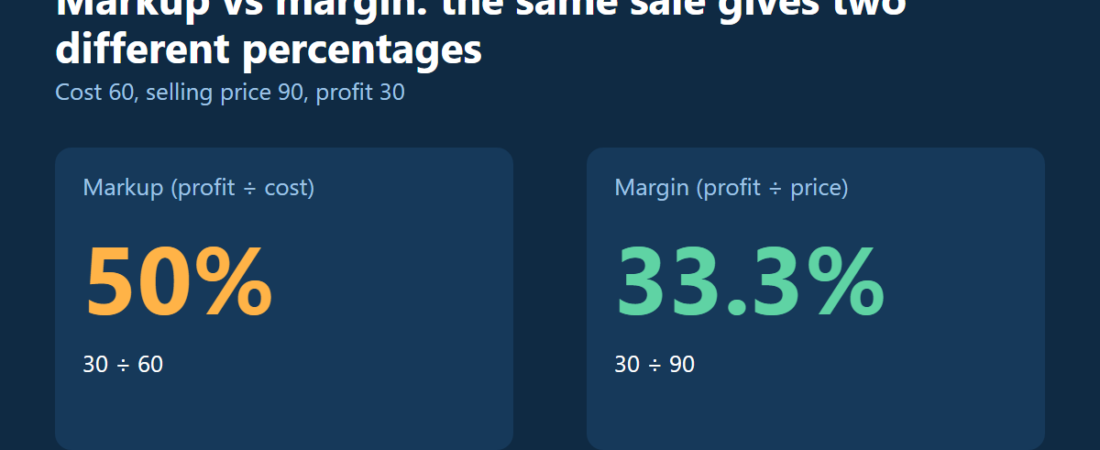
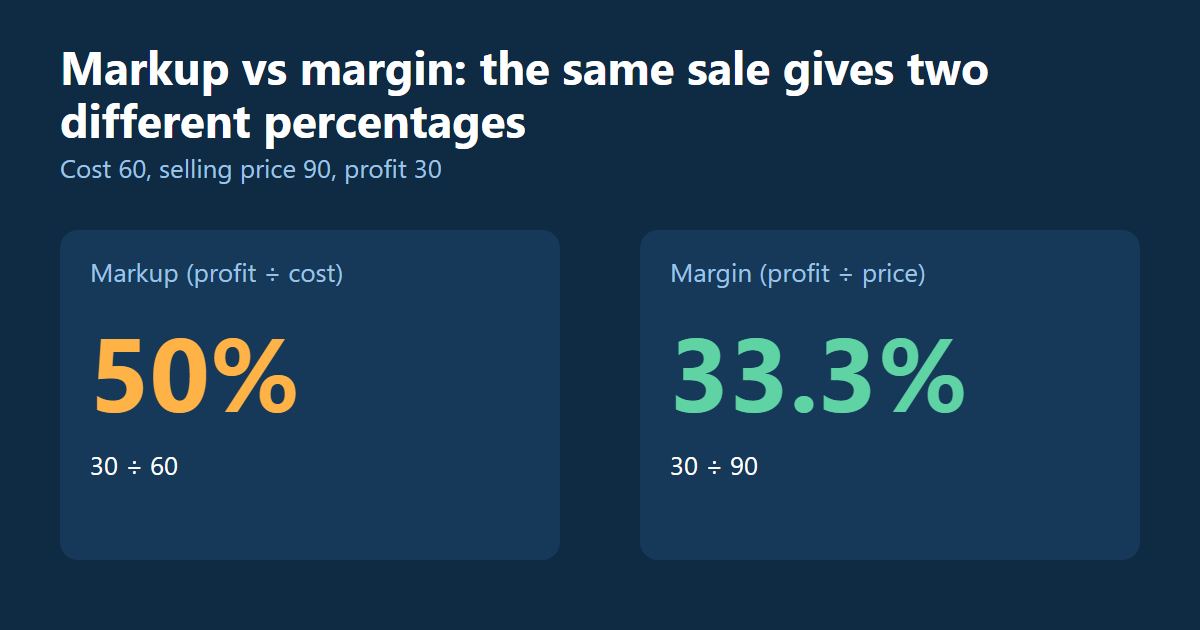
A product that costs you 60 and sells for 90 has a 50% markup and a 33.3% margin. It is one sale with 30 of profit, and it produces two different percentages. People who mix them up tend to price too low, and they usually notice only when the bank balance does not match the spreadsheet.
This guide gives you the formulas, a calculator that converts either way, a conversion table you can pin next to your desk, and four worked examples with real arithmetic.
Markup and margin in one line each
Markup is profit divided by cost. Margin is profit divided by selling price. The profit is identical in both. Only the thing you divide by changes, and because the price is always bigger than the cost, margin is always the smaller number.
Markup and margin calculator
Enter your cost, pick the number you already know, and the calculator fills in the other three. It runs in your browser and stores nothing.
The four formulas
- Selling price = cost × (1 + markup)
- Selling price = cost ÷ (1 − margin)
- Markup = margin ÷ (1 − margin)
- Margin = markup ÷ (1 + markup)
Use decimals in these formulas, so 40% is 0.40. Check the second one with a 40% margin on a cost of 42: 42 ÷ 0.60 = 70. The profit is 28, and 28 is 40% of 70, so the margin holds.
Conversion tables
If you think in margin, here is the markup you need to hit it:
| Target margin | Markup needed |
|---|---|
| 10% | 11.1% |
| 20% | 25.0% |
| 25% | 33.3% |
| 30% | 42.9% |
| 40% | 66.7% |
| 50% | 100.0% |
| 60% | 150.0% |
If you think in markup, here is the margin you actually get:
| Markup | Margin you keep |
|---|---|
| 10% | 9.1% |
| 20% | 16.7% |
| 25% | 20.0% |
| 30% | 23.1% |
| 50% | 33.3% |
| 75% | 42.9% |
| 100% | 50.0% |
| 200% | 66.7% |
The gap widens as the numbers grow. At 10% the two figures are a point apart. At 100% markup the margin is only 50%. A markup can pass 100%, but a margin can never reach it, because that would mean the cost was zero.
Four worked examples
1. Pricing from a markup
Your cost is 60 and your supplier tells you the usual markup in your trade is 50%. Price = 60 × 1.50 = 90. Profit is 30. As a share of the price that is 33.3%, so the margin is a third lower than the markup sounded.
2. Pricing from a target margin
You want to keep 40% of every sale and your cost is 42. Price = 42 ÷ 0.60 = 70. That is a markup of 66.7%. If you had added 40% markup instead, you would have charged 58.80 and kept only 28.6% of it.
3. The 30% markup trap
Take a shop that buys an item for 100 and adds a flat 30% markup, so it sells for 130. The margin is 23.1%. Now suppose running costs such as rent, wages and software come to 25% of revenue, which is 32.50 on this sale. The shop earns 30 and spends 32.50, so it loses 2.50 on every sale, about 1.9% of revenue. The numbers in this example are an illustration, but the pattern is common: a markup that sounds comfortable turns out to be a margin smaller than the overhead.
4. Working backwards from overhead
If overhead is 25% of revenue and you want 10% left as net profit, you need a gross margin of 35%. The markup that delivers it is 0.35 ÷ 0.65 = 53.8%. Starting from the margin you need avoids the trap in example 3. If you do not know your overhead share yet, the break-even calculator is a good place to find it.
Which one should you use?
Use margin when you plan the business, because it is measured against revenue and so lines up with overhead, tax and your profit goal. Use markup at the till or in a quote, because it is quick to apply to a cost you already have. The safe habit is to set the margin first and convert it to a markup with the table above.
Whatever you choose, say which one you mean. When a supplier quotes “30% on top” and your accountant reports “30% margin”, they are describing two different prices.
Fees and discounts cut margin faster than you expect
Say you sell at 100 with a cost of 70. That is a 42.9% markup and a 30% margin. A 3% card fee takes 3 off, leaving 27 of profit, a 27% margin. A 10% discount is harsher. The price falls to 90, the profit falls from 30 to 20, and the margin drops to 22.2%. You gave away a tenth of the price and a third of the profit.
That is why a small price rise can matter more than a big push for new customers. Our guide on raising prices without losing customers covers how to do it, and working out which clients are actually profitable shows where the discounts are hiding. If your margins look fine but the account is empty, read profitable but no cash, and if the cost side is the problem, see how to cut business costs without breaking anything.
Common questions
Is margin the same as profit margin?
In this guide, margin means gross margin: price minus the direct cost of the item, divided by the price. Net profit margin also subtracts overhead, so it is lower.
How do I turn a 50% markup into a margin?
Divide the markup by one plus the markup: 0.50 ÷ 1.50 = 33.3%.
What margin do I need for a 100% markup?
A 100% markup means you charge double the cost, which is a 50% margin.
Can a margin be higher than 100%?
No. Profit cannot be larger than the price you charged. Markup can be any size, because cost can be small compared with profit.