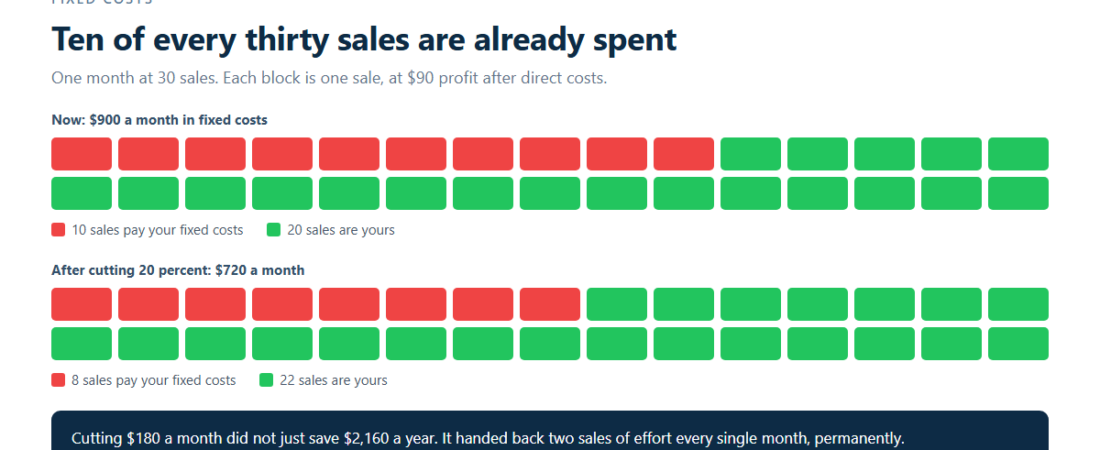
Short answer: cut fixed costs first, because they are the ones you pay whether you sell anything or not. Work through every recurring payment and ask what would actually break if it stopped. Most businesses find 15% to 25% they can remove without anyone noticing, and every dollar of it goes straight to profit.
Cost cutting has a bad reputation because people associate it with panic. Laying people off, dropping quality, stripping the business down until it stops working properly.
That is not what this is. Costs do not arrive through big decisions. They accumulate through small ones, each individually reasonable, and nobody ever goes back to check whether the accumulation still makes sense. The money sitting in that gap is usually substantial and removing it changes nothing about how the business runs.
Why fixed costs deserve your attention first
Every dollar you cut from a fixed cost is a dollar of profit, permanently, every month. Compare that with earning the same dollar through sales, which requires finding a customer, delivering the work, and absorbing the cost of doing so.
The clearest way to see this is to stop thinking about costs in dollars and start thinking about them in sales.
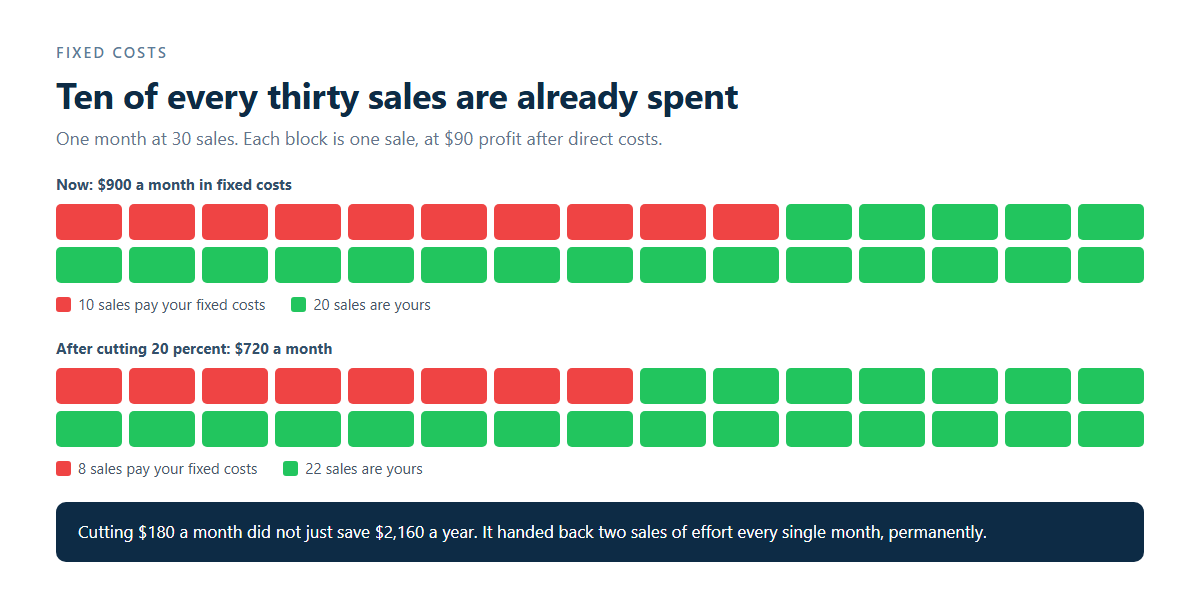
Those first ten sales feel like work because they are, but none of them pay you. Cut the fixed costs to $720 and only eight are needed. You have handed yourself two sales of effort back, every month, without finding a single new customer.
Work out what your costs are costing you
Put in your own numbers. The second field is what one sale leaves you after its direct costs, which is the same contribution figure used in break-even analysis.
For most people the striking number is not the annual total. It is how many sales a year they are making purely to stand still.
The audit: three questions per cost
List every recurring payment from the last three months. Bank statement, card statement, invoices. Do not work from memory, because the whole problem is that memory misses things.
Then put each one through three questions, in order.
- What would break if this stopped tomorrow? If the honest answer is nothing, or nothing anyone would notice within a month, cancel it. This alone usually removes more than people expect.
- Am I paying for capacity I do not use? Plans sized for a busier version of the business, seats for people who left, storage tiers chosen when you were guessing. Downgrade rather than cancel.
- Could this be replaced by something cheaper that is good enough? Good enough is the operative phrase. If the expensive option is genuinely better in a way customers feel, keep it.
Work down the list from the largest payment to the smallest. People instinctively start with the small annoying subscriptions, which is backwards. Twenty minutes on your three biggest costs beats two hours cancelling ten-dollar tools.
Where the money usually hides
| Where to look | What you tend to find |
|---|---|
| Software subscriptions | Tools bought for one project, duplicates that overlap, plans two tiers above what you use, seats for people who have gone. |
| Payment processing | Rates set when you were smaller. Worth renegotiating once volume grows, and the percentage compounds quietly. |
| Insurance and professional fees | Renewed automatically for years without a quote. Often the single largest saving in one phone call. |
| Contractors on retainer | Retainers that made sense during a busy period and quietly outlived it. Move to per-project. |
| Advertising | Campaigns nobody has measured. If you cannot say what a channel returns, that is a finding, not a gap. |
| Storage and hosting | Provisioned for a peak that never came, or for a product you no longer run. |
One specific check worth doing today: look for annual subscriptions that renewed without you deciding. Most people find at least one, and it is money already spent on something unexamined.
What not to cut
This matters more than the cutting. Some costs look like overhead and are actually the business working, and removing them produces a saving this quarter and a problem next year.
- Anything customers can feel. Quality, delivery speed, support responsiveness. Saving money by getting worse is not a saving, it is a slow exit.
- The tools that genuinely save time. If something replaces hours of work, its cost is almost certainly lower than the hours. Check before assuming.
- Backups, security and insurance. These are cheap until the day they are not. Cutting them is buying a small certain gain against a large uncertain loss.
- Your own pay. Owners cut this first because it is the easiest lever to reach. It hides the problem rather than fixing it, and it makes the business look healthier than it is.
- The one channel that actually brings customers. Cut the unmeasured ones. Do not cut the one you can prove works.
What cutting actually achieves
A saving on fixed costs does three things at once, and only the first is obvious.
- It becomes profit immediately. No delivery, no delay, no acquisition cost.
- It lowers your break-even point. Fewer sales are needed each month before you earn anything. You can check the effect in our break-even calculator by changing the fixed costs figure.
- It widens your margin of safety. A lower break-even means sales can fall further before a month turns into a loss, which is what makes a business feel calm rather than precarious.
That third effect is the underrated one. Cost cutting is usually framed as a way to make more money. It is at least as useful as a way to make bad months survivable.
Make it stick
Costs grow back. Every business that has done a serious cost audit has watched the total creep upward again over the following year, because each new addition is individually justifiable.
- Diarise a quarterly review. Fifteen minutes with the statement open. It is the single habit that keeps this from being a one-off.
- Use a separate card for subscriptions. One statement shows the whole picture instead of recurring charges buried among everything else.
- Set a rule for new tools. Anything new replaces something, or it needs a reason beyond seeming useful.
- Cancel during free trials, not after. Cancel immediately and keep using it until it lapses. If you still want it at the end, resubscribe deliberately.
Frequently asked questions
How much can a small business realistically cut?
A business that has never audited its costs will usually find 15% to 25% of fixed costs removable without affecting customers. One that reviews regularly will find much less, which is the point of reviewing regularly.
Should I cut costs or raise prices first?
Cut costs first. It is entirely within your control, takes effect immediately, and carries no risk of losing anyone. Then raise prices, which has a larger effect but needs a conversation. Doing both moves profit faster than either alone.
What is the difference between fixed and variable costs?
Fixed costs are paid whether you sell anything or not, such as rent, software and salaries. Variable costs occur only when you make a sale, such as materials, shipping and payment fees. Cutting fixed costs lowers your break-even point. Cutting variable costs increases what each sale contributes.
Is it worth cutting small subscriptions?
Only after the large ones. A $12 tool is $144 a year, which is real but minor. Renegotiating insurance or dropping an unused retainer can be worth ten times that in a single decision. Start at the top of the list.
How do I stop costs creeping back up?
Review quarterly, keep subscriptions on one card so they are visible in one place, and require anything new to replace something existing. Creep happens through invisibility, so the fix is making the total easy to see.
The short version
Pull three months of statements, list every recurring payment, and ask what would actually break if each one stopped. Start with the biggest. Expect to remove somewhere between a sixth and a quarter of your fixed costs without any customer noticing.
Every dollar removed is profit that needs no selling, and it permanently lowers the number of sales you need each month. Costs quietly climbing is one of the most common reasons a business stays busy without becoming profitable.
Related reading
More on profit and growth: