Singapore’s Productivity Solutions Grant covers up to 50% of the cost of business software, and the scheme is being expanded to support AI-enabled solutions. So a reasonable assumption is that if you buy an AI tool, you can claim half of it back.
That assumption is wrong, and it is an expensive one. PSG does not fund AI tools as a category. It funds specific pre-scoped packages from pre-approved vendors. Whether your tool uses AI is close to irrelevant. Whether it appears on the approved list is everything.
Here is what actually qualifies, what does not, and the four rules that disqualify claims after the money has been spent.
The short answer
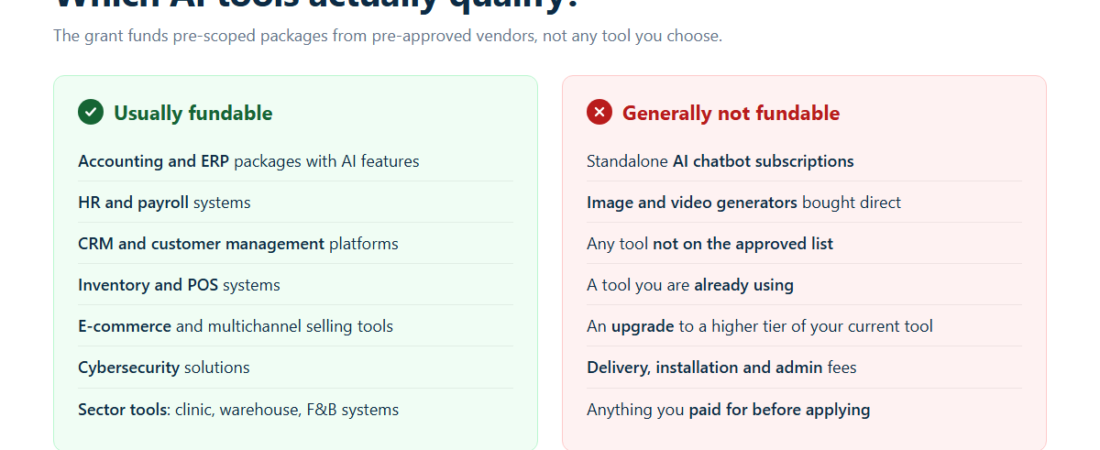
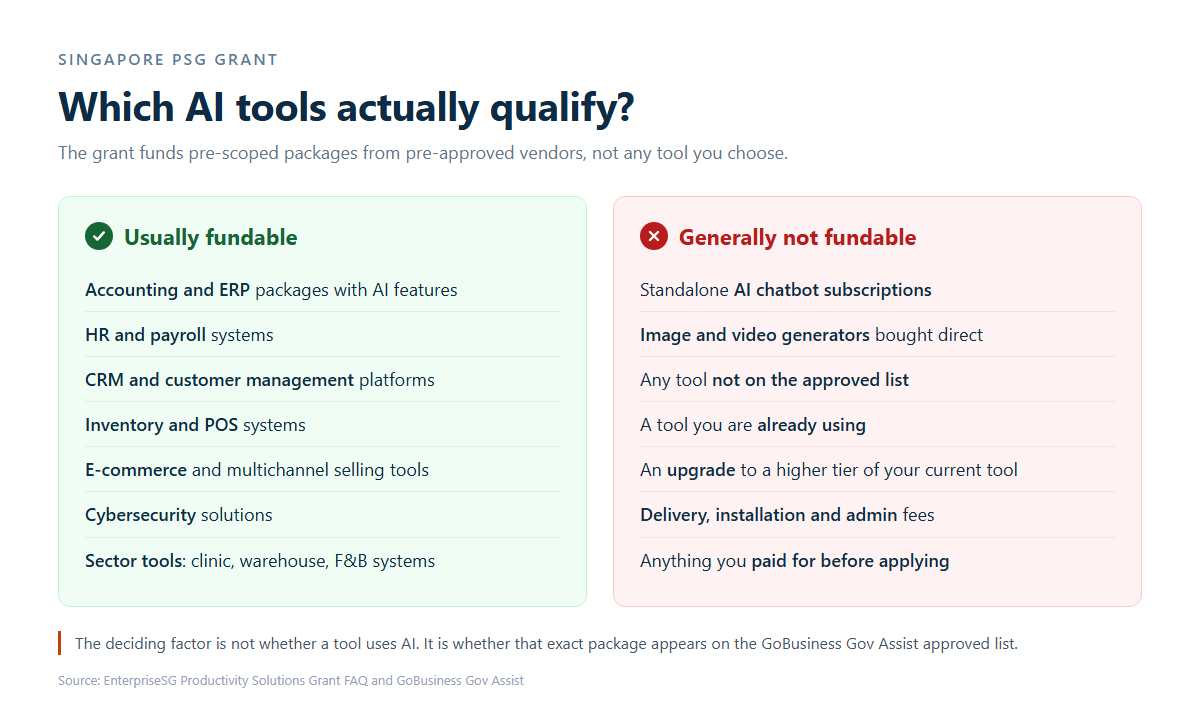
PSG funds business software packages that have been pre-approved by Enterprise Singapore and its partner agencies. Accounting, HR, CRM, inventory, e-commerce and cybersecurity systems are commonly covered. Standalone AI subscriptions bought directly from a vendor, such as a general chatbot or image generator, are generally not.
Why “it uses AI” is the wrong question
PSG was built around a catalogue. Enterprise Singapore and its partner agencies vet specific products from specific vendors, scope exactly what is included, and publish that as an approved package on GoBusiness Gov Assist. You choose from the catalogue. You do not nominate your own tool and ask for it to be assessed.
This is why the AI question misleads people. A modern accounting platform with AI-driven reconciliation is fundable because the accounting package is on the list. A best-in-class AI writing tool with no approved package is not fundable, however useful it is. The AI is incidental either way.
There is real movement here worth knowing about. Under Budget 2026, PSG is being expanded to support digital and AI-enabled solutions for firms of all sizes, and the whole scheme is being folded into a new grant called EDGE in the second half of 2026. EDGE funds activities rather than a fixed product list, which is a structurally better fit for software that changes this fast. We covered that transition in detail in our guide to the EDGE grant.
What is typically covered
The catalogue spans generic business systems and sector-specific tools. Broadly, these categories appear:
| Category | What it typically covers |
|---|---|
| Accounting and ERP | Bookkeeping, invoicing, financial reporting, increasingly with automated reconciliation |
| HR and payroll | Payroll processing, leave and claims, employee records |
| Customer management | CRM platforms, sales pipelines, customer service systems |
| Inventory and POS | Stock control, point of sale, order management |
| E-commerce | Online store builders, multichannel selling and marketplace integration |
| Cybersecurity | Endpoint protection, email security, backup and recovery |
| Sector-specific | Clinic management, warehouse management, F&B systems, construction modelling |
Note what these have in common. They are systems of record that a business runs its operations on, not point tools that one person uses occasionally. That is a useful mental model for guessing what is likely to be on the list before you check.
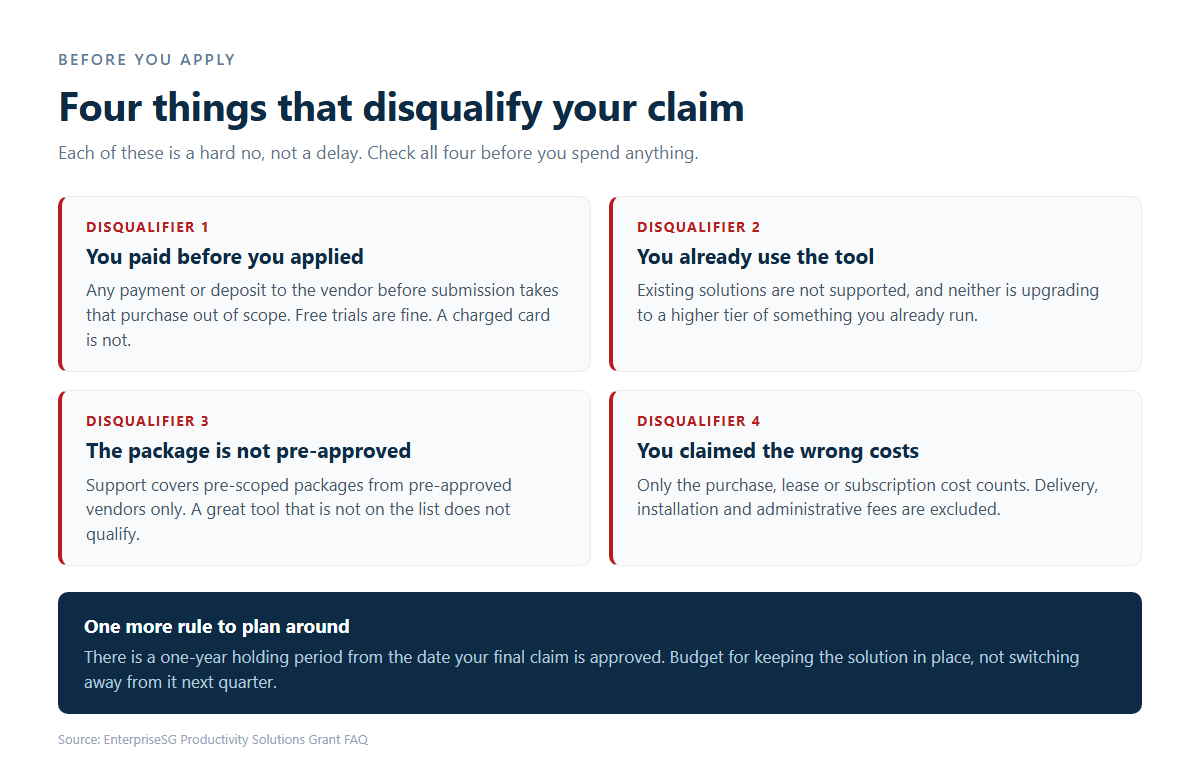
Four rules that disqualify claims
These are the ones that catch people out, because each is absolute rather than a matter of degree.
1. Paying before you apply
Any payment or deposit to the vendor before you submit the application removes that purchase from scope. This is the single most common failure, and software makes it worse: the instinct with a SaaS product is to start a paid plan, confirm it works, then handle the paperwork. Do that and you have bought it yourself. Free trials are fine. A charged card is not.
2. Already using the tool
This one is under-reported and it surprises people. Enterprise Singapore’s guidance is explicit that companies will not be supported if the application covers a solution they are already using, or a higher tier of a solution they are already using.
In practice that means you cannot run a tool on a starter plan for a year, decide it works, and then claim the upgrade to its business tier. The grant is designed to fund adoption of something new, not to subsidise your existing stack.
3. The package is not pre-approved
Support covers pre-scoped packages from pre-approved vendors only. Vendors are sometimes loose about this in their marketing, advertising themselves as “PSG supported” when only one specific tier or bundle is actually approved. Verify the exact package on GoBusiness rather than trusting the vendor’s own page.
4. Claiming costs that are excluded
Only the actual purchase, lease or subscription cost of the approved package is supportable. Related charges such as delivery, installation and administrative fees are excluded. If a vendor quotes you a bundled figure, ask them to itemise it before you submit.
One more rule that is not a disqualifier but does affect planning: there is a one-year holding period for the solution, running from the date your final claim is approved. Choose something you intend to keep.
How to check a tool in four minutes
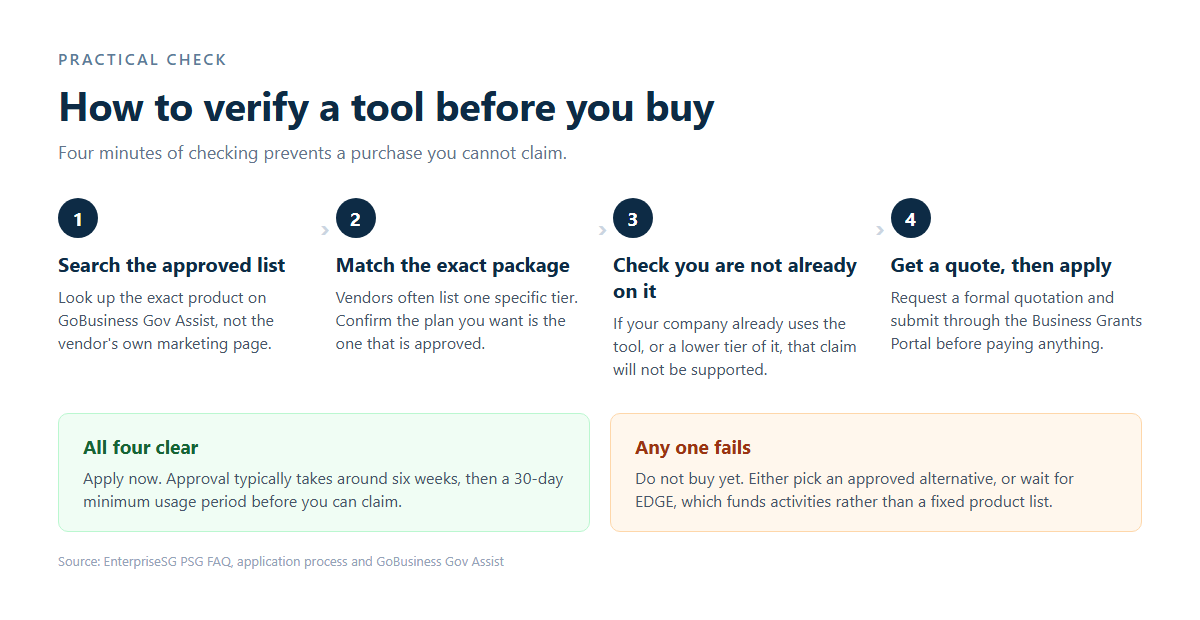
- Search the product on GoBusiness Gov Assist. Use the official listing, not the vendor’s marketing page.
- Match the exact package and tier. Confirm the plan you actually want is the approved one.
- Confirm you are not already on it. Including any lower tier of the same product.
- Get a formal quotation, then apply through the Business Grants Portal using Corppass, before paying anything.
If the tool clears all four, applying is straightforward. Approval typically takes around six weeks, followed by a minimum 30-day usage period before you can submit a claim. Budget three to four months from application to money landing.
What to do if your tool is not on the list
You have three sensible options, and one bad one.
- Find an approved equivalent. If the job is CRM or accounting, there is very likely an approved package that does it. The specific brand matters less than the outcome.
- Wait for EDGE. Because it funds activities rather than products, a tool that fails the list test today may qualify under the new scheme. Worth waiting if your spend is significant.
- Buy it anyway, unfunded. Perfectly rational for a tool costing a few hundred dollars a year. Do not contort your operations around a grant.
The bad option is choosing an inferior approved tool purely because it is funded. A 50% discount on software that does not fit your business is not a saving. If you are still working out which tools you actually need, start with our roundup of AI tools for small businesses and the automation platform comparison, then check funding after you know what you want.
Frequently asked questions
Can I claim PSG for a ChatGPT or Claude subscription?
Generally no. PSG supports pre-scoped packages from pre-approved vendors, and a general-purpose AI subscription bought directly is not usually one of them. AI capability delivered inside an approved business system is a different matter and may well be covered.
Are SaaS subscription costs claimable, or only one-off purchases?
Subscription costs are supportable. Enterprise Singapore’s guidance covers the actual purchase, lease or subscription cost of the approved package. What it excludes is the surrounding charges, such as delivery, installation and administrative fees.
Can I upgrade my existing software using PSG?
No. Applications are not supported where the solution, or a lower tier of it, is already in use by the company. The scheme funds new adoption rather than upgrades to your current stack.
How much can I claim in total?
PSG covers up to 50% of eligible costs, with an annual cap of S$30,000 for solutions supported by Enterprise Singapore, running from 1 April to 31 March. Under EDGE, that annual cap rises to S$100,000.
Does a one-person company qualify?
Yes, if it is registered and operating in Singapore, has at least 30% local equity, and meets the group turnover or headcount test. There is no minimum company size, and plenty of very small businesses use the scheme.
What happens to PSG when EDGE launches?
PSG remains open until EDGE launches in the second half of 2026, and applications already approved are honoured. A project in progress is not affected by the transition.
Sources
- EnterpriseSG, Productivity Solutions Grant
- EnterpriseSG, PSG frequently asked questions
- EnterpriseSG, Budget 2026 measures
- GoBusiness Gov Assist, approved solutions list
Grant terms, approved vendor lists and pricing change. Figures here reflect Enterprise Singapore guidance as published in August 2026. Confirm current details on the official pages before you apply, and treat the GoBusiness listing as the authority on whether a specific package qualifies.
Working through an application? We turned the rules on this page into a step-by-step Singapore AI Funding Checklist, covering eligibility, what qualifies, what to prepare, and the five mistakes that cost people money.
Related reading
Keep going with these Velzeno guides: